
Pairings & clutches
From pairing through clutch through hatchlings.
Pairings & clutches
Available on Adult plan and above.
The breeding pipeline is: pair animals → record copulation events → log the clutch → bulk-add hatchlings → grown animals.
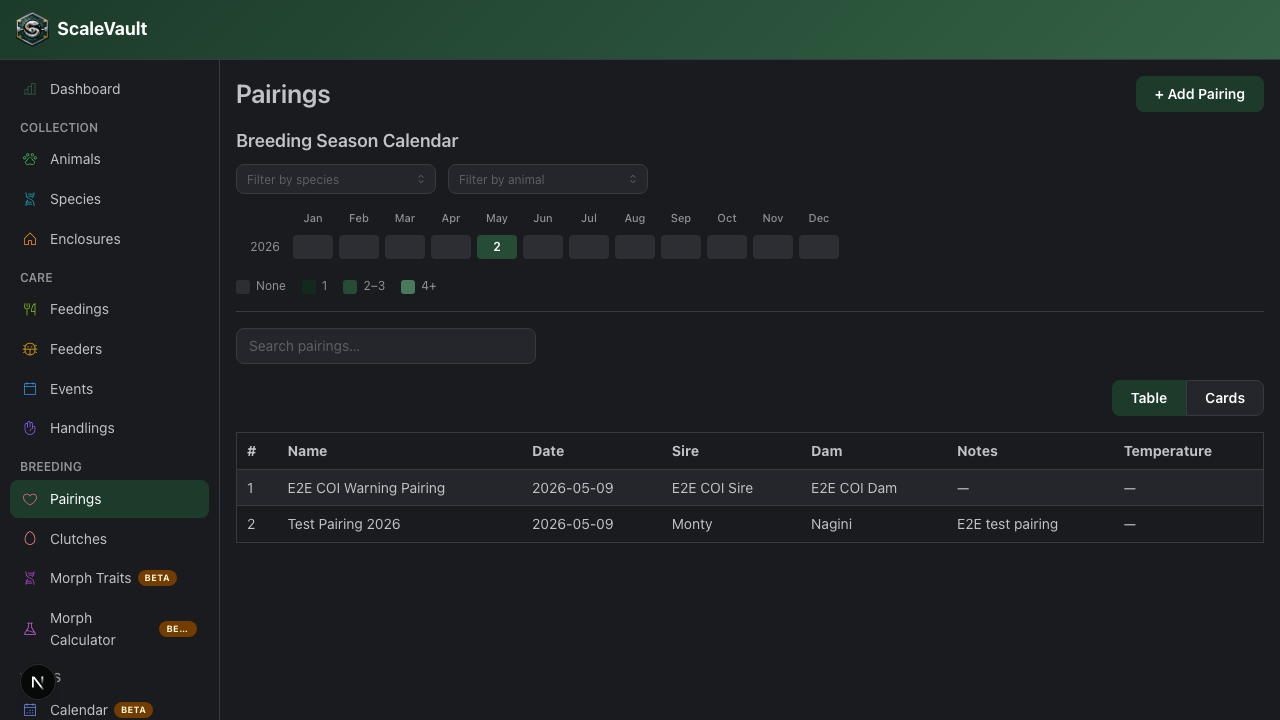
Pairings
A pairing is a logged intent to breed two animals. Create one at
/pairings → + New pairing.
- Sire and dam must be different animals and must have opposite sex.
- Either side can be left blank if you don't have the parent in ScaleVault yet (e.g. an unknown wild-type female).
- Add observations as Events under the pairing — lockings, dates, refusals.
Inbreeding warnings (COI)
When you select a sire and dam, ScaleVault automatically calculates the Coefficient of Inbreeding (COI) for the predicted offspring. COI is expressed as a percentage: how likely a random allele in the offspring is to be identical by descent from a common ancestor.
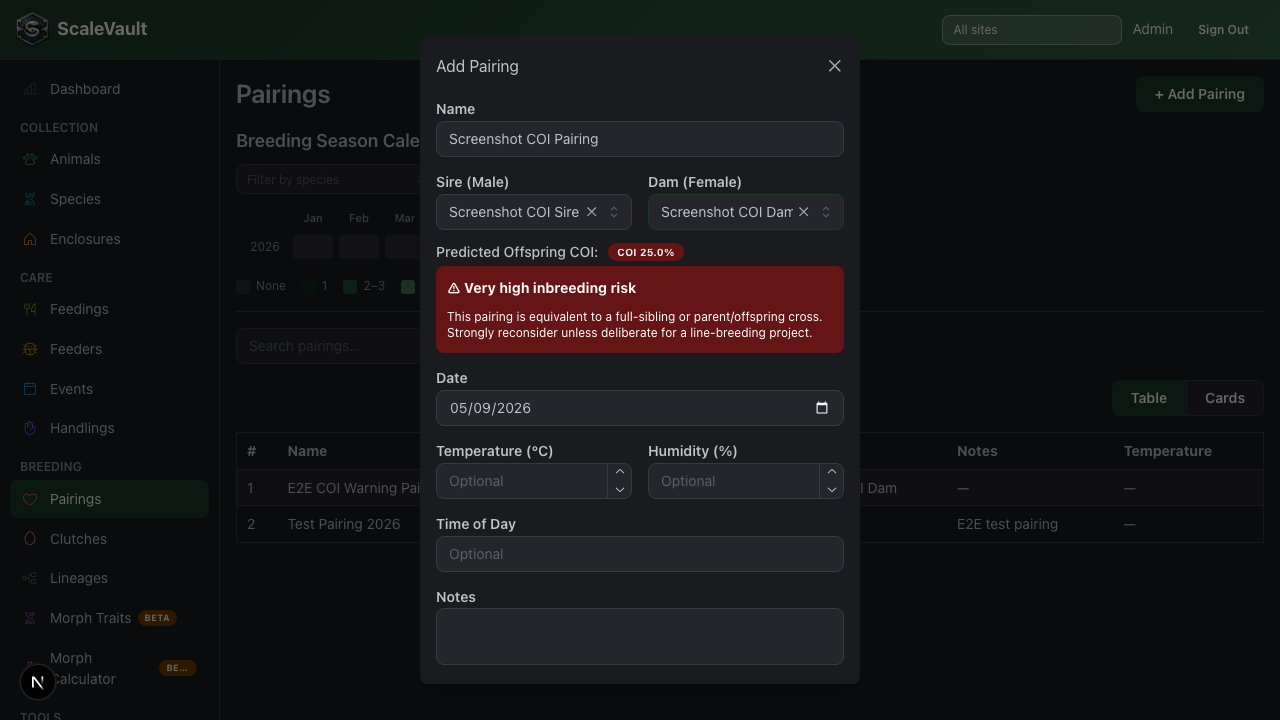
The COI badge and risk level update live as you change the selected animals:
| Badge color | COI range | Risk level |
|---|---|---|
| Green | < 6.25% | Low — typical for unrelated animals |
| Yellow | 6.25–12.5% | Moderate — second-cousin-equivalent |
| Orange | 12.5–25% | High — first-cousin-equivalent |
| Red | ≥ 25% | Very high — full siblings or parent/offspring |
A red warning banner ("Very high inbreeding risk") appears when COI reaches 25% or above, equivalent to a full-sibling or parent/offspring cross. ScaleVault will still let you save the pairing — line-breeding is a legitimate practice — but the warning is there to catch accidental close relatives.
COI is only calculated when both animals have their sire and dam recorded in ScaleVault. The more generations of pedigree data you have, the more accurate the estimate.
Clutches
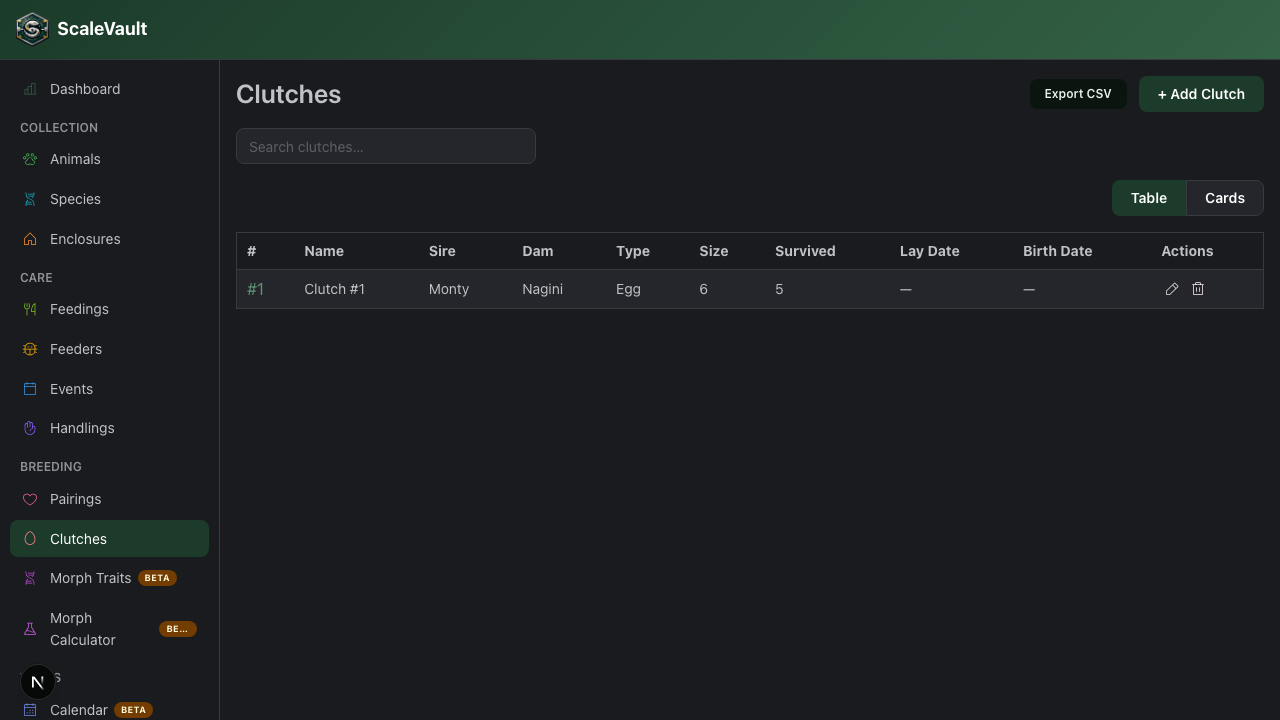
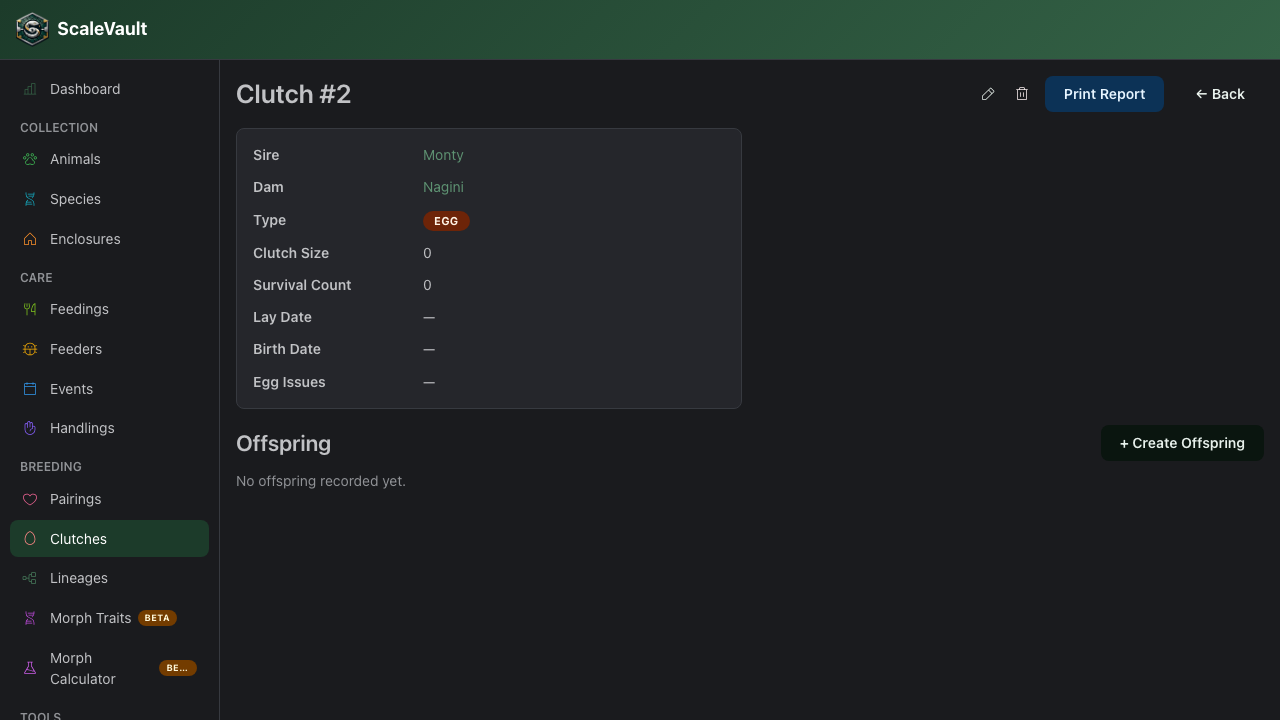
When eggs are laid (or live young arrive), open the pairing and click + Clutch. Fields:
- Lay date — when eggs were laid.
- Birth date — when they hatched (fill in later).
- Live birth? — checkbox for live-bearers.
- Clutch size — count of eggs / babies.
- Survival count — fill in as hatchlings emerge.
- Egg issues — slugs, deformities, infertile, banded, etc.
- Incubation temperature range — overrides the species default.
- Incubation humidity range — overrides the species default.
- Incubation days — automatically defaults from species.
Bulk offspring
Once the clutch hatches, click + Bulk offspring on the clutch detail page. Enter the count and a base name (e.g. "CG-2026-"). One animal record is created per hatchling, all linked to the clutch and inheriting parents from the pairing. You can edit individual records (weight, morph, sex) afterward.
What ScaleVault calculates for you
- Sire & dam are auto-set on offspring → enables COI calculation (see Inbreeding warnings).
- Pairing-level survival rate rolls up from the clutch's survival_count / clutch_size.
- Clutch size and hatch dates become season analytics on the pairings table.
Tip: name pairings consistently
Many breeders use a season-prefix scheme like 2026-S1 or
Coral Glow x Pinstripe (2026). Anything you can grep for later
works.